How to measure for an EVAR
Before an endovascular aneurysm repair, the CT is measured to choose a stent graft that will seal: above the aneurysm in the healthy neck of the aorta, and below it in each common iliac artery. Five measurements decide it. This guide goes through them in the order they're taken, the way the practice grades them.
What the video shows
- How to measure for an EVAR.
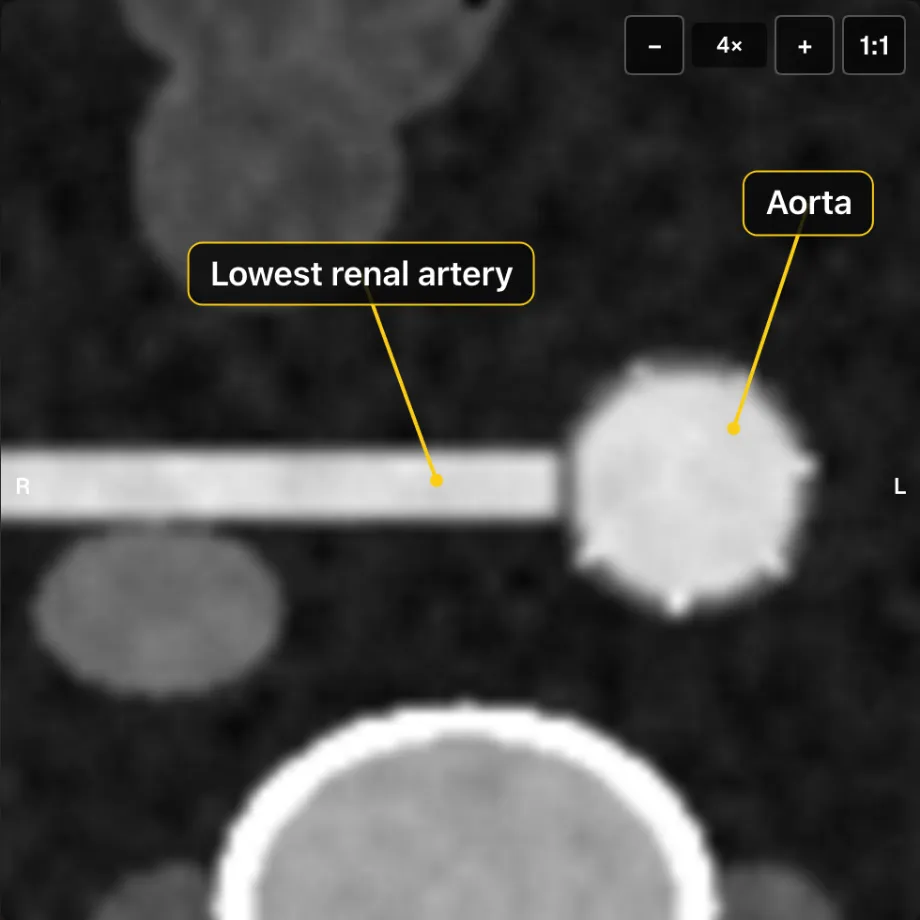
- Scroll down until the lowest renal artery leaves the aorta. The neck starts just below it.
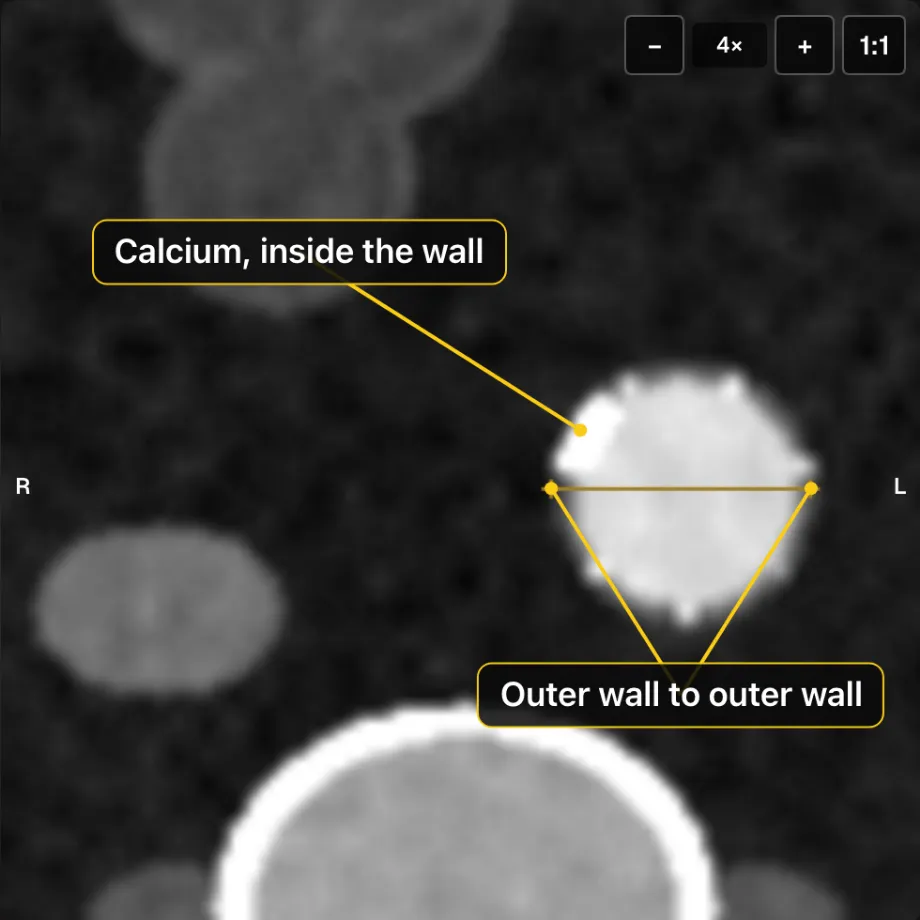
- Measure the neck from outer wall to outer wall, across the short axis if it's oval.
- Thrombus and calcium sit inside the wall, so the outer edge is still the one to measure.
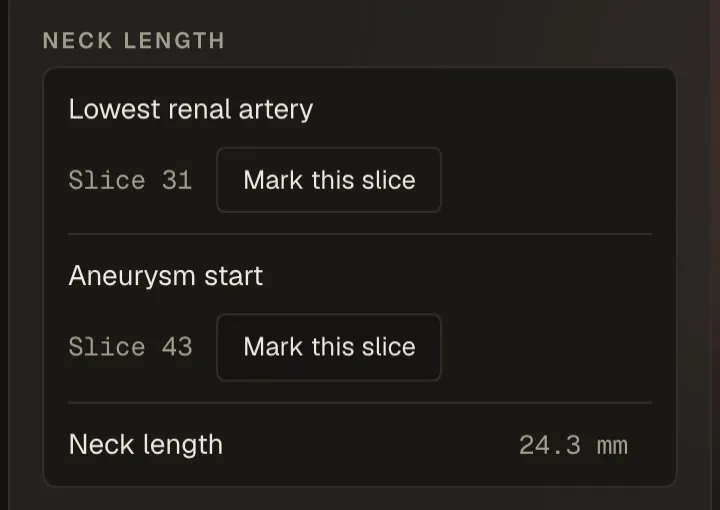
- Mark the lowest renal, then the slice where the aorta first widens by more than 10%.
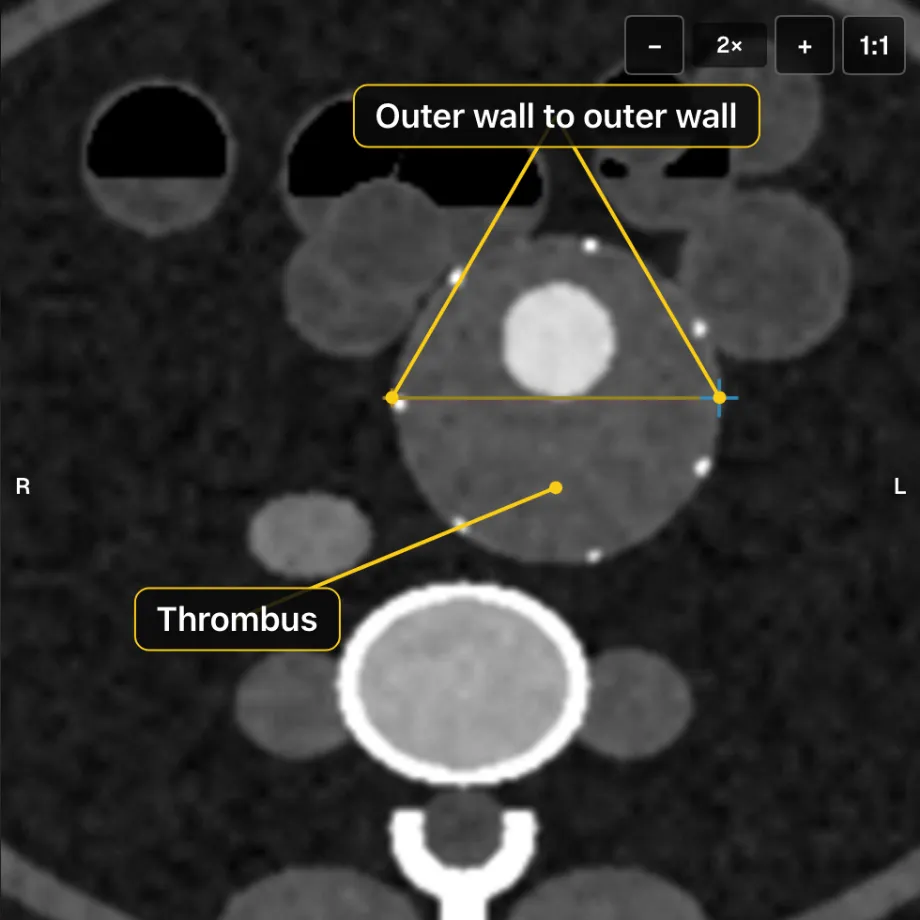
- Find the widest slice of the sac and measure it outer wall to outer wall.
- Below the bifurcation, measure each common iliac where the limb will seal.
- Then pick the main body from the neck's diameter and each limb from its iliac.
- Check your answers. On Medium, diameters count within 2 mm and the neck length within 5 mm.
- The guide goes through every step with pictures. Start on Easy.
1Find the top of the neck
Scroll down from above the kidneys. The renal arteries leave the aorta to either side, and the neck starts just below the lowest of them, which can be on either side. In the practice, mark that slice as the lowest renal artery.
On every axial CT the patient's right is on the left of the image, so the right renal artery heads left.
2Measure the neck
Just below the lowest renal, put the calipers across the neck from outer wall to outer wall, thrombus included. Calcium and thrombus sit inside the wall, so even when the bright lumen is narrower, the outer edge is the one to measure to.
If the neck cuts as an oval, it's angled, and the slice is cutting through it on a slant. Measure across the short axis: that's the vessel's real diameter, and the long axis only shows how steep the slant is.
3Mark the neck length
Mark the lowest renal, then the first slice where the aorta widens by more than 10%. That's where the aneurysm starts, and the neck runs between the two. Most devices need at least 10 to 15 mm of it to seal.
The practice measures that length along the vessel's centreline rather than straight down the slices, so a leaning neck comes out a little longer than its slice count.
4Measure the widest part of the sac
Scroll through the aneurysm to its widest slice and measure it outer wall to outer wall, across the short axis if it's oval. Include the thrombus: it's part of the aneurysm, even though the bright lumen inside it is narrower.
5Measure both common iliacs
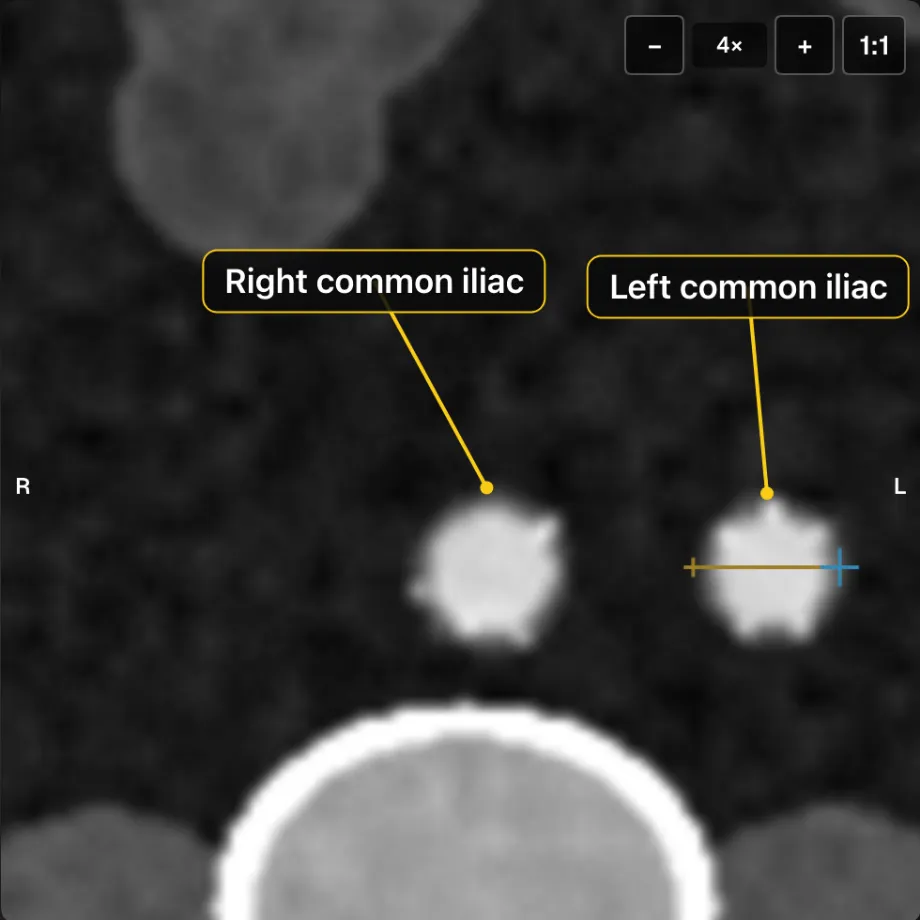
Below the aortic bifurcation, measure each common iliac outer wall to outer wall where its limb will seal: clear of the bifurcation, and above where the internal iliac comes off. Each side gets its own number, since they're rarely the same.
6Size the graft
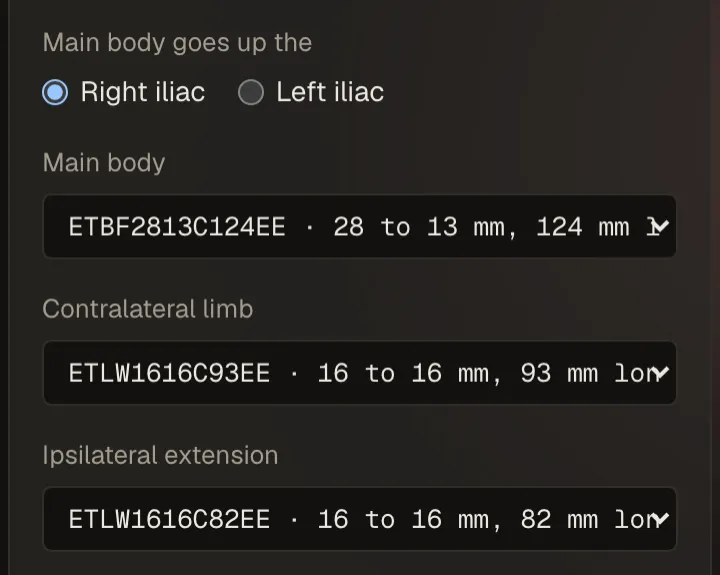
Each maker publishes a table that turns a measurement into a device size, and the sizes are deliberately a little bigger than the vessel, usually 10 to 20% for the neck, so the graft presses outward and seals. Pick the main body from the neck's diameter and each limb from its iliac.
On the long straight neck case, the 23 mm neck takes a 28 mm main body on Medtronic's Endurant sheet, and the 14 mm right iliac and 13 mm left iliac each take a 16 mm limb.
Mark the aortic bifurcation and each internal iliac origin too, and the practice grades the lengths: each side has to reach at least 15 mm into its common iliac without covering the internal iliac.
7Check your answers
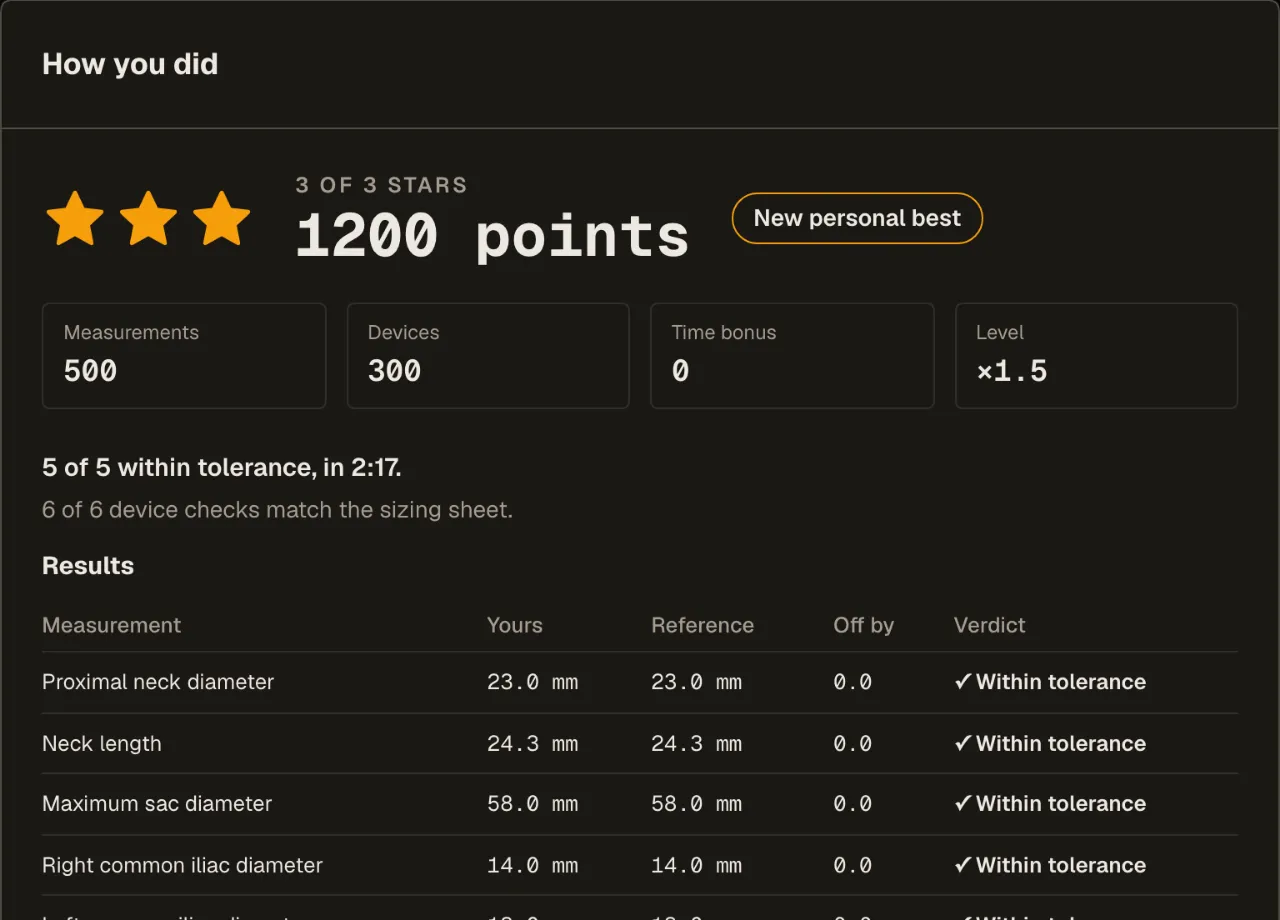
Each number is compared with the reference, within a tolerance set by the level.
- On Easy, diameters count within 3 mm and lengths within 8 mm, with hints on which slices to look at.
- On Medium, diameters count within 2 mm and lengths within 5 mm.
- On Hard, diameters count within 2 mm and lengths within 5 mm, with 5 minutes on the clock.
Two millimetres is about where experienced readers disagree with each other on a diameter. Stars count the measurements alone; points add the graft and your time. A measurement that doesn't count links back to its step here.
Common mistakes
- Measuring the bright lumen instead of the outer wall, when thrombus or calcium lines the vessel.
- Measuring across the long axis of an oval, which is the slant of the cut, not the vessel.
- Starting the neck at the higher renal artery instead of the lowest.
- Taking the neck diameter too low, where the aorta has already started to widen.
- Measuring the iliacs at the bifurcation itself, rather than where the limbs will seal.
What real planning adds
The practice teaches the core measurements on axial slices. Planning a real repair goes further, usually in dedicated software such as 3mensio, TeraRecon Aquarius, Siemens syngo.via or OsiriX, and every device has limits in its instructions for use that the case has to fit.
- A centreline. The CT, taken at about 1 mm slices, is rebuilt in three dimensions, a line is drawn down the middle of the vessel, and diameters are measured at right angles to it. An axial slice only approximates that, which is why the practice asks for the short axis.
- Neck angles. The angle above the renals and the angle below them. Devices allow roughly 45 to 60 degrees above and 45 to 90 degrees below, depending on the device.
- Neck shape. Diameters at the lowest renal and 5, 10 and 15 mm below it, to catch a neck that widens on the way down.
- Calcium and thrombus. How much of the neck's circumference they line. Devices allow up to about half.
- The aortic bifurcation and the access arteries. The aorta has to be wide enough where the limbs sit, 12 to 21 mm depending on the device, and the smallest external iliac wide enough for the delivery sheath, 5 to 8.5 mm on the main body's side.
- The branches. Accessory renal arteries, the inferior mesenteric artery and the lumbar arteries, which can keep filling the sac after a repair.
By the ESVS definition, a neck is hostile when it's shorter than 10 mm, wider than 28 mm, angled more than 60 degrees, conical, or heavily lined with thrombus or calcium.
Sources
- ESVS 2024 guidelines on abdominal aorto-iliac aneurysms (EJVES)
- Medtronic Endurant II/IIs instructions for use (FDA)
- Gore Excluder Conformable specifications
- Sizing considerations for Gore Excluder in angulated necks, Annals of Vascular Surgery
- Knöps et al., EVAR sizing with open source software, Annals of Vascular Surgery 2021
For practice only. Not for planning a real patient's repair: each device's instructions for use are the source of truth.